
How to Stop
Rumination
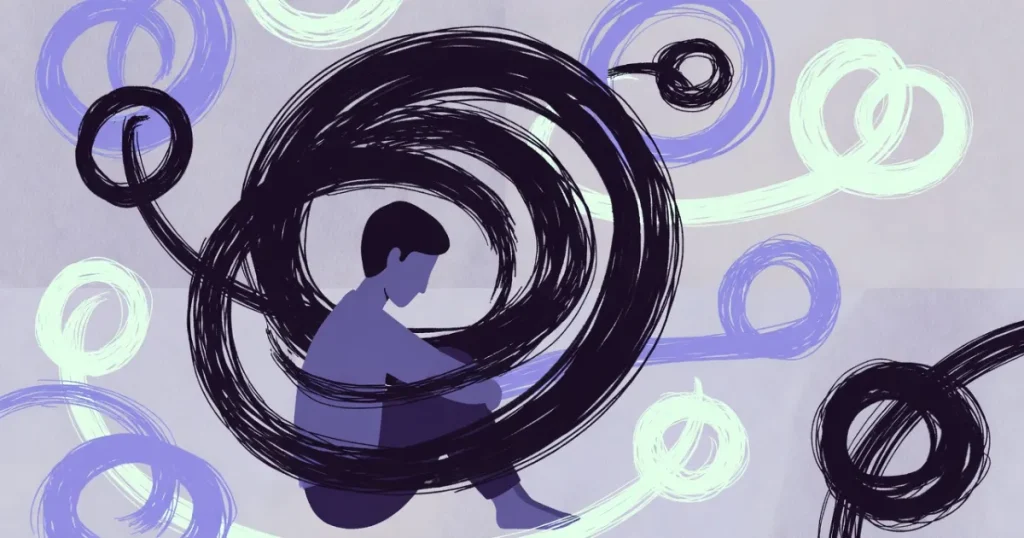
Rumination is darker than ordinary overthinking. It’s not just repetitive — it’s self-critical, past-focused, and closely tied to depression. Understanding the difference changes what you do about it.
What rumination is
The word comes from the Latin ruminare — to chew cud. Which is apt. The mind returns to the same material again and again, without digesting it or moving on.
Clinical psychologist Susan Nolen-Hoeksema, who did more to define rumination than anyone, described it as dwelling on distressing feelings and their causes in a way that is self-focused, abstract, and passive — the opposite of active problem-solving. You’re not analyzing to find a solution. You’re analyzing because stopping feels impossible.
Overthinking tends to be future-focused and anxiety-driven — “what could go wrong?” Rumination is past-focused and depression-linked — “what went wrong, what does it say about me, will it ever get better?” Both involve repetitive thinking, but they’re different problems and they respond to different interventions.
Rumination vs. overthinking
🔁 Rumination
- 📌 Past-focused (“What did I do wrong?”)
- 📌 Self-critical (“What’s wrong with me?”)
- 📌 Deepens depression
- 📌 Passive, abstract
- 📌 Linked to major depressive disorder
- 📌 Often triggered by loss or failure
⚡ Overthinking
- 📌 Future-focused (“What could go wrong?”)
- 📌 Threat-anticipating (“What if it fails?”)
- 📌 Worsens anxiety
- 📌 Urgent, restless
- 📌 Linked to anxiety disorders
- 📌 Often triggered by uncertainty
How the cycle works
Rumination doesn’t just happen — it feeds itself. Each stage makes the next more likely.
Withdrawal removes the activities that might break the loop — making the next episode more likely.
Why it’s worth taking seriously
Rumination has a well-documented relationship with clinical depression — not just as a symptom but as a cause. According to Nolen-Hoeksema’s research, people who ruminate take longer to recover from depressive episodes and are more likely to experience future ones. It also worsens anxiety, PTSD, and eating disorders.
In practical terms: rumination impairs concentration, makes decisions harder, and tends to lead to social withdrawal — which removes the exact things that might break the loop.
If your rumination involves persistent feelings of hopelessness, worthlessness, or thoughts of self-harm, please speak with a mental health professional. These are depression symptoms that respond well to treatment — and they’re not things to manage alone.
What actually helps
Switch from “why” to “how”
Rumination thrives on abstract “why” questions: “Why does this keep happening to me?” Concrete thinking asks “what” and “how” instead: “What specifically happened? What’s one thing I could do?” Research by Edward Watkins at the University of Exeter found that training people to think concretely reduces both rumination and depressive symptoms significantly — and the effect lasts.
Break the withdrawal pattern
Rumination causes withdrawal; withdrawal deepens rumination. Even a small pleasurable activity — a walk, a shower, fifteen minutes of music — activates the brain’s reward system and creates a gap in the loop. Schedule at least one absorbing activity per day. Not because it solves anything, but because the loop needs interruption to weaken.
Decentering: thoughts aren’t facts
Mindfulness-Based Cognitive Therapy was designed specifically to prevent depression relapse driven by rumination. Its core skill is decentering — observing your thoughts from a distance rather than being caught inside them. Daily mindfulness practice of 20+ minutes builds this capacity over time. It’s one of the few interventions with strong evidence for preventing future depressive episodes.
Question the belief that ruminating helps
Adrian Wells’ Metacognitive Therapy targets the underlying belief that rumination is useful — “I need to understand why this happened before I can move on.” Often that belief is the problem, not the original event. MCT challenges these metacognitions directly and trains the ability to redirect attention away from the loop on demand.
Talk about it once — properly
Talking through a painful event with someone you trust can reduce its charge. But co-rumination — going over the same material repeatedly with others who also worry — is as damaging as solo rumination. The distinction: productive talking moves toward understanding or acceptance. Co-rumination just replays.
Self-compassion as an exit
Rumination runs on self-criticism. Kristin Neff’s research shows that self-compassion — treating yourself with the same care you’d offer a close friend — deactivates the threat system that keeps the loop going. Studies show it reduces both the frequency of rumination and depression severity, and it outperforms positive self-talk.
When it’s about a specific person
Replaying interactions with an ex, a colleague, or a family member is one of the most common and stubborn forms of rumination. A few things that tend to help:
- Absorption-based distraction — tasks requiring full attention (puzzles, creative work, learning something new) leave no room for the loop
- Narrative processing — write the full story once, with context and meaning, then close it
- Radical acceptance (from DBT) — accepting that what happened happened, because resisting reality extends the pain
- Reducing cue exposure — temporarily stepping back from social media profiles, shared playlists, or other triggers isn’t avoidance; it’s just managing the environment while the loop weakens
Common questions
What is the difference between rumination and overthinking?
Overthinking is future-focused and anxiety-driven — anticipating what could go wrong. Rumination is past-focused and depression-linked — replaying what went wrong, what it says about you, and why. Both involve repetitive thinking, but rumination is more persistent, more self-critical, and more closely tied to depressive episodes.
How do I stop ruminating about someone?
Use tasks that require full concentration, practice cognitive defusion to observe thoughts without engaging, and reduce cue exposure for a while. If the rumination is about grief or loss, allow yourself to process it — suppression tends to make things worse. But set gentle limits on how long you dwell in any single session.
Is rumination a symptom of depression?
Yes — and a cause. Research shows rumination both signals and prolongs depressive episodes. Treating it directly is now considered a target in its own right in depression therapy, not just a side effect to manage.
Can I handle rumination without therapy?
Mild to moderate rumination often responds well to self-help strategies — particularly the concrete thinking technique, mindfulness, and self-compassion. Severe or persistent rumination tied to depression usually needs professional support. CBT and MBCT have the strongest evidence, and they work faster with guidance than alone.